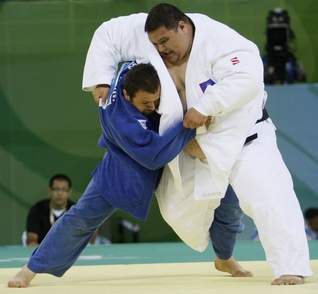
Guam R.J. Blas ( White) AP Photo
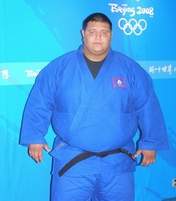
Ric


Blas takes opponents to the wire
Penalties prove costly for Blas in second match
BY JOJO SANTO TOMAS • PACIFIC DAILY NEWS • AUGUST 16, 2008
BEIJING— R.J. Blas went through a whirlwind of emotions yesterday during his judo competition at the 2008 Beijing Olympics.
The short story is that he fought and lost, then fought and lost again. He lost his first match to Lasha Gujejiani of Georgia, who lost the bronze medal match to former world champion Teddy Riner of France.
The long story is that he went the distance with the best the U.S. could offer, kept things close and lost by the slimmest of margins.
In Blas’ opening match, Gujejiani made a strong counter on a Blas attack early, kept a strong grip and half-threw Blas, resulting in a waza-ari, or half-point. The Georgian then spent much of the rest of the match protecting his powerful lead, even earning a penalty for inaction.
Blas’ coach, Atef Hussein, was disappointed that the Georgian wouldn’t engage, but as a former silver medalist for Egypt, he respected Gujejiani’s wily experience. He was proud of R.J., he said, and was happy that he earned the Olympic experience.
A second waza-ari came with just 39 seconds left in the match, ending it and presumably, Blas’ Olympic experience. R.J. Blas, the Little Mountain from Guam, was crushed.
Asked his thoughts after his first match, Blas took a long time to answer. Sweat poured down his bruised face as he tried to control his emotions. He wasn’t tired but there was no doubt he was emotionally drained. Just like every other Olympic athlete from Guam before him, he thought, he went one and done.
He had finished his first match, so he didn’t fail by his standards. But he had so wanted to fight more than once.
“I was confident. I thought I had him a couple of times. But I guess …” he trailed off and didn’t finish. He was sure Gujejiani wouldn’t make it to the semifinals, dashing his hope of getting a second fight.
“I’m sorry I let you down,” he said, after a long time, addressing the people of Guam. “Thank you for your support and, … God bless.”
But Gujejiani won, beating U.S.favorite Dan McCormick. And then Gujejiani won again, this time against an Iranian. He advanced far enough to give Blas another chance in the loser’s bracket.
Blas was matched up against McCormick, a 6-foot-5, 307-pound fighter who was nimble on his feet. Blas was familiar with his game, as he and McCormick both trained in Tokai, Japan, early last year and were friends.
The match was exciting. Neither player could secure any advantage. McCormick had no chance to throw Blas, who entered the contest at 464 pounds. But Blas, who stood six inches shorter against the burly mainlander, couldn’t get an advantage either.
It came down to penalties. It was tied early on with both players scoring a shido, a point awarded for an opponent retreating off the mat. As the minutes ticked by, McCormick scored another shido, but Blas answered that too and the two were tied again.
With 2:04 left, Blas nearly scored on a powerful throw but McCormick turned at the last second, preventing a point. He countered but Blas responded.
With 30 seconds to go, McCormick forced Blas off the mat again, gaining the advantage in points. Blas looked exhausted as he searched for a weakness that McCormick would not yield. Time ran out.
“Dan is a taller opponent and I gave him a run for his money, he’s a tough opponent, a well-respected opponent, and I did my best. Dan is just a tough opponent and he deserves his place,” said Blas. “I wish it could have gone some other way, but, … these are the consequences of my actions.”
McCormick lost his next match to Iranian Mohammad Rodaki and finished ninth. He was happy to have beaten Blas but would have preferred to fight someone else.
“It was a real technical match, it was just all penalties. It was hard, but I had a lucky couple calls there,” he said. “He’s definitely got weight on his side and he’s a strong kid. The whole time we were just trying to fight, trying to get better angles and control over each other. Of all the people here, I would want to fight him least. We’re pretty good friends.”
 Tasithoughts' Weblog

Congratulations, La’hen Guam–perfecto Chamorro. Hu ta’tiyi hao desdi anai hu’li’i hao ginen i tini’tuhon!
Sen seramiento,
Si Tan Mina
The Learning of a Martial Art Skill
The learning of a (martial art skill) can be greatly facilitated if certain basic steps are followed. First
we should obtain a full understanding of the skill desired, intended purpose, when it is to be employed,
the mechanics of its execution, and results of its application… Next, we must watch a skilled performer
demonstrate the action, perhaps on a reduced speed basis so that the construction of the technique is
presented. At this time, we must attempt to mentally picture what to do as we follow the demonstration.
This demonstration phase should be repeated several times to clearly present to the student the pattern
of the technique and the movements required. Thirdly, we must individually begin the movement from a
crude state of awkward imitation with failures and varying degrees of success to the final state of a
polished and correctly executed reflex action. It is at this point that the instructor is vital, for he must
correct, adjust, and advise the performer so that mistakes are gradually eliminated. Through constant
repetition, the desired movement is developed, and at last we no longer concern ourselves with minute
details of the execution. We pass on from mechanical imitation to reflex action via a nervous circuit
which has been developing in response to adequate stimuli. Such a circuit will improve with use. There
can be no muscular sense of a movement we have never made. Such a sense has to be developed by
constant repetition of a movement utilizing (a repetitive) style of training. Students and instructors alike,
must understand and utilize this training method.
Excerpt taken from:
“Judo” Training Methods
Written by Takahiko Ishikawa
& Donn Draeger
Thank you for the information, Daniel.
JP
Well…excellent achievement to Ric Blas or known as “little mountain.” We are proud of you as well as keep up the great job!Nice pictures of your!!!
Thank you for your comments, Guam Base!
I thinkn for a sportsman the qualification for olympic games is a great step in the sportive career. Even though little mointain lost a competition, he van be very, very proud!